
What is Pickleball?
Published on 15/01/2026 in Guide to Sports
Pickleball is one of the fastest growing sports in UK, with now over 40,000 people taking up the sport. More schools are bringing in Pickleball since it has been put on the curriculum, thanks to its ability to be played indoors or outdoors. It was invented in Washington State, USA in 1965 as a children’s backyard game, and over the last five years has really grown globally.
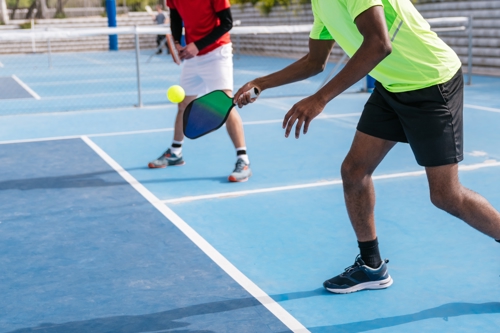
It is uniquely a paddle sport played on a small court that combines elements of tennis, badminton, and table tennis. It can be played indoors or outdoors, in singles or doubles, and uses solid paddles and a lightweight perforated plastic ball. Pickleball is known for being easy to learn, low impact, and suitable for all ages and ability levels.
How Do You Play Pickleball?
Pickleball is played by serving the ball underarm across the court into the diagonal service box. After the serve, the ball must bounce once on each side before players are allowed to hit it in the air. Points can only be scored by the serving side, and games are typically played to 11 points, with a two-point winning margin.
Court and Equipment
Pickleball is a paddle sport that combines elements of tennis, badminton, and table tennis. It’s played on a smaller court (similar size to badminton court) with a modified tennis net, a perforated plastic ball and solid paddles.
What Equipment Do You Need for Pickleball?
To play Pickleball, you need:
A Pickleball paddle (solid, lightweight, no strings)
A Pickleball (plastic ball with holes)
A court similar in size to a badminton court
A pickleball net slightly lower than a tennis net
Most beginners can start with basic equipment, and many schools and clubs provide paddles and balls.
Basic Rules
Pickleball can be played in singles or in a doubles team. The ball must be served underhand and diagonally. Only the serving team can score points. The ball must bounce once on each side before volleys are allowed (this is called the “double bounce” rule). There is also a non-volley zone near the net where players cannot hit the ball in the air (this is called the “Kitchen”)
Why is it popular?
There is lower impact on the legs meaning that it is great for all ages. It is still fast paced and social, plus it is easier to learn than tennis. It is cheaper for schools and clubs to set up, and more people are getting interested.
Its adaptability and community-focused culture have helped drive rapid growth in participation.
Is Pickleball Good for Fitness?
Yes. Pickleball improves:
Cardiovascular health
Balance and coordination
Agility and reaction time
Mental focus and decision-making
Because it involves frequent movement but less court coverage than tennis, it provides effective exercise with reduced injury risk.
Who Is Pickleball Best For?
Pickleball is suitable for:
Beginners with no racket-sport experience
School-aged children learning fundamental movement skills
Adults looking for social sport and fitness
Older players seeking low-impact physical activity
Players returning to sport after injury
Its inclusive design allows people of mixed abilities to play together.
Feature | Pickleball | Tennis |
|---|---|---|
Court Size | Smaller (badminton-sized) | Larger |
Equipment | Solid paddle, plastic ball | Racket, pressurised ball |
Learning Curve | Quick | Steeper |
Impact Level | Lower | Higher |
Accessibility | Very high | Moderate |
Pickleball in the UK: Growth and Governance
In the UK, Pickleball is overseen by Pickleball England, the national governing body working to support clubs, schools, coaches, and competitive pathways. The sport’s rapid growth has led to an increase in local clubs, recreational leagues, and national tournaments across England, Scotland, and Wales. Leisure centres and sports halls are increasingly adapting existing badminton courts to accommodate Pickleball, making access easier than ever.
The inclusion of Pickleball in school curriculums reflects a broader push to introduce accessible, lifelong sports that encourage participation rather than early specialisation. Teachers and sports coordinators value Pickleball for its simple rules, quick learning curve, and ability to engage pupils of mixed abilities.
Safety and Injury Prevention
Pickleball is considered a low-risk sport compared to many court-based activities, but basic safety principles still apply. Wearing appropriate court shoes with good grip can help prevent slips, while warming up before play reduces the risk of muscle strains. Because rallies can be fast-paced, players are encouraged to communicate clearly in doubles matches to avoid collisions.
As participation grows, coaching qualifications and structured training are becoming more widely available, supporting safe progression from recreational to competitive play.
The Future of Pickleball
With continued growth in schools, clubs, and leisure centres, Pickleball is well positioned to become a long-term fixture in the UK sporting landscape. Its adaptability, affordability, and inclusive design align closely with modern approaches to physical education and community sport. As awareness increases and infrastructure expands, Pickleball is likely to attract even more players looking for a fun, accessible, and engaging way to stay active.
Author

Gareth Pashley
Sports Content Writer & Marketing Specialist
Grassroots football coach and keen sports enthusiast, passionate about developing players, building confidence, and fostering a love for the game at every level.