
Allocating the Primary PE and Sport Premium for the 2025-26 academic year
Published on 14/10/2025 in Primary Schools
In our second Diary of a PE Lead we talked to one teacher about their preparations for the Primary PE and Sport Premium for the next academic year 2025-26.
Diary entry #2
How much funding will we get and when will schools receive it?
Following the very recent DfE announcement about this year’s Primary PE and Sport Premium for 2025-2026, we have just had confirmation that our school (a maintained school) will receive £16,000 plus £10 per pupil for this academic year. It’ll be released in two tranches to our Local Authority (LA):
Payment 1 (50%): 31st October 2025
Payment 2 (50%): 30th April 2026
Meaning we’ll effectively have a greater amount to spend in the Summer Term. I’m aware that other types of schools will receive their payment directly from the DfE on the following timeline:
Academies and free schools
Payment 1 (50%): 10th November 2025
Payment 2 (50%): 11th May 2026
Non-maintained special schools
Payment 1 (50%): 18th December 2025
Payment 2 (50%): 17th April 2026
With the release now confirmed, the Head has asked me to start planning.
Creating a PE and Sport Action Plan for 2025-26 – Key Objectives
At the end of the last academic year (July), I started formulating my main focuses for 2025-26 to form the basis of my Action Plan.
This plan outlines the intended priorities and outcomes for this year regarding PE, sport and physical activity across the school - and how the PE and Sport premium allocation for 2025-26 will facilitate this. It will also help me to monitor the progress towards these objectives, establish suitable timelines and measure the impact of the PE and Sport premium grant.
For our school, the main areas for development and improvement will be to:
Increase the confidence, knowledge and skills of all staff teaching PE and sport by providing continued professional development (CPD) opportunities - to create a legacy of confident staff who can deliver PE lessons of the highest quality and promote health and wellbeing in all of our children.
Encourage and increase the engagement of our pupils in regular physical activity by:
- embedding physical activity throughout the school day to promote better concentration and higher retention of learning.
- incorporating the use of quick ‘active blasts’/brain breaks during lessons e.g. using a programme such as iMoves to give short bursts of energy and get oxygen flowing to the brain.
- encouraging active travel to and from school, e.g. Walk to School initiatives.
- providing targeted activities or support to involve and encourage the least active children e.g. widening our current offering of sports and activities for extra curricular activities by introducing lesser-known sports and activities.
- ensuring that access to sport and physical activity is available at different times throughout the school day i.e. before school, lunch time and after school clubs so more children have the opportunity to participate.
- introducing a morning fitness and well-being club twice a week. Children will come into school early to take part in a fun, ‘wake-up, shake-up’/’morning move it’ style activity to music conducted in the playground, weather-permitting, so that all can join in, including parents/carers, toddler siblings etc.
Introduce a broader range of sports and activities offered to all pupils – we aim to offer a well-balanced mix of sports and physical activities in each half term by combining the more traditional sports offered such as football and netball with lesser known/tried ones such as boccia, curling and archery.
Continue to provide specialist support to help children with additional needs to access and participate fully in PE lessons – this is where the inclusive range of sports that I have been looking at could be very useful.
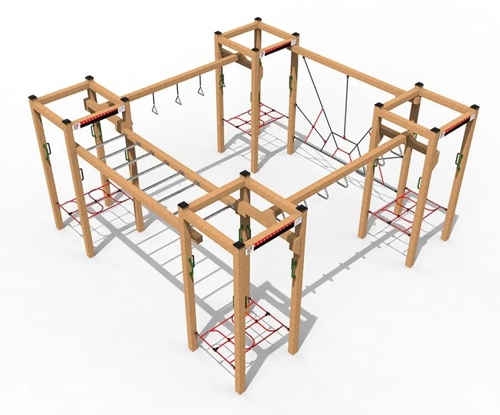
Increase physical activity at playtimes and lunchtimes – setting up more active zones e.g. designated outdoor equipment such as a multi gym/active trail such as this:
We’ll also create opportunities for pupils in Years 5 and 6 to take on Playground Leader roles where they can lead the younger children in focused games and activities using the designated equipment.
Encourage a greater participation in competitive sport – continuing our involvement in inter-school competitions in our area e.g. for football, netball, athletics, swimming, and trying to widen the scope of this.
Acknowledge and celebrate pupils’ sporting achievements outside of school - by finding out from pupils themselves and parents/carers about their involvement in sport away from school e.g. participation in community clubs for football, gymnastics, swimming, rugby, martial arts, dance etc. We’ll use pupil and parent voice questionnaires to find this out.
Encourage wider participation in sport and physical activity by linking up with local sports teams/community projects in our area – by reaching out to, and inviting, community-based sports teams e.g. community arms of Premiership football teams, Rugby clubs, Cricket clubs, to see if they offer any outreach opportunities e.g. Burnley FC in the Community. It says the aim of its ‘Primary League Primary Stars’ programme is “to create positive and lasting sporting, health and education outcomes for children, young people and the wider community”.
Monitoring the impact of the PE and Sport Premium
One of the ways I will monitor and assess the success of these objectives is to conduct a staff and pupil/parent voice survey in Autumn 1. This will enable me to find out how the children currently feel about P.E. and their attitudes towards physical activity within school. I will then repeat this questionnaire in Summer 2 for comparison.
I will also ensure that I have a clear timetable for effective spending of the PE and Sport Premium funding, which I will regularly monitor throughout the year.