
Use dance to build friendship
Published on 21/01/2026 in Primary Schools
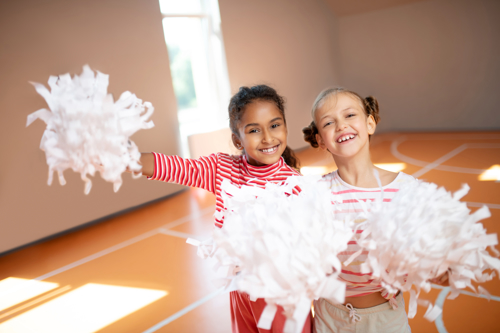
In a landscape of rising child obesity, poor mental health and primary school children reporting evermore pressure in their day-to-day lives, we’ve been exploring how active movement in school can help tackle these issues. Building positive, inclusive time into the school day can have positive effects.
We spoke to Imogen Buxton-Pickles, founder of imoves, an online platform that delivers all-in-one Primary PE lesson plans to empower teachers to deliver session confidently. With her extensive experience teaching and building resources, Imogen gave us her take on how dance can be a powerful vehicle in children developing friendships and alleviating anxiety.
How dance builds friendships and helps ease anxiety in primary schools
“Watch a group of children dancing together in a PE lesson, a school disco or just on the playground, and you’ll see something amazing happening.
Yes, there’s movement, music and plenty of enthusiasm but underneath that, dance is doing some quiet, important work for friendship, confidence and anxiety.
For Children’s Mental Health Week, especially with the focus on “Where is my place?”, dance offers a very practical way to help primary school children feel they have a place with others.
Dance is a shortcut for children to build social connections
Children don’t always find it easy to start conversations or join in with new peers. Dance offers a kind of social shortcut:
The music provides a shared focus so no one has to think of what to say
Simple routines give structure so that everyone is learning the same steps
There is room for playfulness, moments of individuality, and fun
In that environment, friendships can grow more naturally, especially for children who might struggle in more traditional social situations.
Every child can join in a school dance session
One of the strengths of dance in primary schools is that it is inherently inclusive:
There are no right or wrong body types
Children don’t have to be “sporty” to feel successful
Movements can be adapted for different abilities and needs
A well-planned dance session uses six building blocks: travel, turn, jump, gesture, balance and different levels. That gives children who often feel ‘on the edge’ of PE a chance to feel, “this is something I can do.”
That sense of competence and belonging is crucial for wellbeing. It’s hard to feel part of a group if you constantly feel behind. Dance, done well, can flip that experience for many children.
Why dance can help with anxiety
We’re seeing more children in primary schools experiencing worry, tension and anxiety. Dance can support them in several ways:
1. Physical release
Anxiety isn’t just in the mind; it’s also in the body, tight shoulders, knotted stomachs, jittery hands. Dancing allows children to shake, stretch and move through some of that tension in a way that feels fun, not clinical.
2. Breathing and rhythm
Moving to music can steady breathing and uplift mood. Children are practising skills that support regulation.
3. Being in the moment
Learning a new routine or responding to music demands focus. For anxious children, that can offer a brief break from rumination, a chance to be absorbed in something enjoyable and shared.
4. Success experiences
Completing a short routine, performing a section with a partner or contributing an idea to a class dance gives children a sense of achievement: “I did that.” Repeated success experiences, even tiny ones, are protective factors against anxiety.
Of course, dance is not a replacement for professional support where needed but as part of a whole-school approach, it can play a valuable role.
TIP: Use soft gymnastics apparatus as a mechanism to build different types of movement and routines.
Dance as a friendship builder
There are some very practical reasons why dance is so good at building friendships:
Many activities involve mirroring, where partners copy each other’s moves. This requires close attention and often leads to shared smiles and laughter
Group dances rely on cooperation and timing where children have to work together to make the pattern work
Choreography tasks invite children to share ideas, negotiate and value each other’s contributions
Over time, these experiences can:
Breakdown cliques (because groups are mixed up and everyone contributes)
Give quieter children a way to connect without having to fight for airtime
Allow children to see each other’s strengths in new ways (“I didn’t know you were so good at…”)
Teachers often see new friendships forming or existing relationships softening through regular dance sessions.
Dance for Children’s Mental Health Week
For Children’s Mental Health Week, the theme “Where is my place?” invites us to help children explore:
Where do I feel I belong?
Who feels like “my people”?
What helps me feel safe and accepted?
Dance can contribute to this exploration in some very concrete ways:
My Body, My Place - using simple movements to help children feel comfortable and proud in their own bodies.
My Classroom, Our Place - creating a class dance where each child adds a move that represents something about them: a hobby, a favourite place, a feeling.
My School, Everyone’s Place - building a short whole-school or year-group dance that celebrates strength and togetherness.
These activities don’t need to be polished performances. In fact, it’s often the practice sessions, with their giggles, mistakes and small victories, that do most of the friendship-building work.
TIP: Use existing gymnastics equipment in your school to facilitate different routines
Keeping dance lessons manageable for teachers
A common worry is: “But I’m not a dance teacher.” The good news is you don’t have to be. Effective primary dance is usually built around:
Reusable structures (warm-up, learn, create, share, cool-down)
Simple movement vocabularies (shapes, directions, levels, speeds)
Clear themes (friendship, journeys, celebrations) children can relate to
Structured programmes, like imoves’ primary dance resources, are designed to support non-specialists with:
Clear video examples
Progressive units from EYFS to Year 6
Built-in ideas for differentiation and assessment
I love using ribbons, scarves, pom poms and floor spots as props, which help children feel safe and less exposed. Discover more dance essentials at Davies Sports here
Dancing towards belonging
When I think about dance in schools, I don’t picture perfect lines or West End-style choreography. I picture:
A child who rarely speaks putting their hand up to share a move.
A boy who would only play football admitting he also loves dance
Two pupils who don’t usually get on, laughing as they finally nail a tricky pattern together.
A class who, for three minutes, are completely absorbed in moving as one.
Those are the moments when you can almost see the thought forming:
“This is my place. These are my people.”
In the context of Children’s Mental Health Week (and beyond) that’s a powerful outcome for something as simple and joyful as a dance lesson.”
Author: Imogen Buxton-Pickles, primary PE specialist and founder of imoves